
Mutooroo Ridge
Mutooroo Ridge Project
100% MAGNETITE MINES OWNED
Discover the
Mutooroo Ridge Project
The Mutooroo Ridge Project is located within the Broken Hill Domain of the Curnamona Province in north-eastern South Australia.
The project is held under Exploration Licence EL 6877, which is 100% owned by Magnetite Mines Limited, and covers approximately 78 km² and is located around 60 km south-east of Olary in South Australia’s North East Pastoral District. The project lies immediately south of the Company’s Muster Dam Iron Ore Project.
Mutooroo Ridge forms part of Magnetite Mines’ broader South Australian exploration portfolio and represents an opportunity to evaluate copper–silver mineralisation within the Curnamona Province.


PROJECT HIGHLIGHTS
-
Copper–silver mineralisation confirmed through re-assay of archived diamond drill core originally drilled by Longreach Minerals Limited in the late 1960s and early 1970s.
-
Re-assay program focused on historic drill hole DDH M7, selected based on historic data (DEM-SARIG), geological observations and visible copper mineralisation in archived core.
-
Core was accessed, re-logged and re-sampled from the South Australian Department for Energy and Mining State Core Library.
-
Independent geological review by Spectrum Consultants confirmed copper–silver mineralisation within the Boucaut Volcanics.
-
Results support the presence of a copper–silver mineralised system at Mutooroo Ridge, with copper intersections exceeding 0.2% Cu and up to 2.8% Cu.
Key Results
Recent drilling results confirm a copper–silver mineralised system at Mutooroo Ridge.
-
High-grade copper and silver mineralisation identified through re-assay of archived diamond drill core from the Mutooroo Ridge prospect.
-
Results confirm multiple copper intersections and two zones of high-grade silver mineralisation from historic drill core.
-
Results support the presence of a copper–silver mineralised system hosted within the Boucaut Volcanics.
-
Next steps: further evaluation of the mineralised system, including assessment of potential extensions along structure and at depth.
Copper Intercepts
-
11m at 1.40% copper from 146m, including 1m at 2.8% copper
-
7m at 1.10% copper from 191m, including 1m at 2.44% copper
Silver Intercepts
-
8m at 38.5 g/t silver from 147m, including 1m at 63.2 g/t silver
-
3m at 20.0 g/t silver from 192m, including 1m at 26.3 g/t silver

Geology
Mutooroo Ridge is a 16 km long northeast-trending ridge comprising deformed volcanic and sedimentary rocks.
The copper prospect lies near the intersection of two major regional structures, a geological setting considered favourable for the movement of mineralising fluids and the development of copper mineral systems.
Historic exploration identified copper mineralisation associated with a dacitic tuff unit approximately 50 metres thick developed along a key volcanic contact. Surface expressions of mineralisation are typically limited to minor copper oxide staining, including atacamite and chrysocolla, together with gossanous quartz veining, while historic drilling has identified sulphide-style copper mineralisation at depth.
Recent re-assay work supports the presence of copper–silver mineralisation within this geological setting, although additional exploration will be required to determine the extent and continuity of the mineralised system.


Historic Exploration
Exploration at Mutooroo Ridge has been undertaken intermittently since the 1960s.
The most significant copper-focused exploration was carried out by Longreach Metals between 1969 and 1973, including geophysical surveys, surface geochemistry and diamond drilling. This work intersected copper–silver mineralisation and identified the Ridge as a copper target.
Follow-up drilling by Tricentrol Australia between 1973 and 1975 tested extensions of the mineralisation, while Newmont Pty Ltd conducted deeper drilling in 1977. However, significant drill hole deviation prevented deeper mineralisation from being effectively tested. Subsequent drilling broadly reconfirmed mineralisation near the DDH-M7 drillhole however limited work to extend known mineralisation has been done and further work is required to test extent and continuity.
As a result, systematic copper-focused exploration at Mutooroo Ridge has historically been limited, particularly at depth.


Recent Work
Magnetite Mines has undertaken a modern reassessment of historic exploration at Mutooroo Ridge through the re-logging and re-assay of archived diamond drill core.
The core, originally drilled by Longreach Minerals Limited, is securely stored at the South Australian Department for Energy and Mining State Core Library.
After receiving the necessary permits, the Company accessed the core and completed independent re-logging and sampling with specialist geological consultants Spectrum Consultants. The program focused on lithology, alteration, structure and the distribution of copper mineralisation.
During the review, geologists observed visible copper mineralisation, including copper oxide minerals such as atacamite and chrysocolla, developed along fractures and within altered host rocks.
Inspection of the archived core also indicated that some mineralised intervals were only partially sampled during historic drilling, suggesting earlier exploration may not have fully captured the extent of mineralisation intersected by drilling.
These observations supported a systematic re-assay program using modern analytical techniques, improving the geological understanding of the copper–silver mineralised system at Mutooroo Ridge.
-
Adjacent to EL6126 (Ironback Hill)
license covers approximately 227km2 -
Secures downstream drainage corridors
interpreted to be associated with the shallow, clay-hosted REE mineralisation previously reported at Ironback Hill. -
No exploration activities have yet taken place
-
Planned objectives:
-
Compilation and review of existing data
-
Refinement of regolith and drainage-based REE targets
-
Reconnaissance mapping and surface geochemical sampling along priority drainage systems.
-
Potential follow up drilling
contingent on results of planned objectives above.

THE RAZORBACK IRON ORE PROJECT REDEFINED
5 MILLION
tonne per annum - Stage 1
DR-Grade
Concentrate
In response to industry feedback and emerging market developments, in September 2022 Magnetite Mines announced its decision to increase the scale of the first stage of the Razorback Iron Ore Project to a minimum of five million tonnes of production per annum (“Mtpa”) and to assess a number of other Project enhancements including the production of DR-grade concentrates.
The strategic shift to a larger-scale, staged development of the Razorback Iron Ore Project represents a compelling opportunity to capitalise on its substantial resource base and the favorable mineral processing characteristics of Braemar ores.
The Project’s current Mineral Resource Estimate of over three billion tonnes, including two billion tonnes of Probable Ore Reserves, is based on a limited number of drilling programs. The majority of the Project’s 110km strike zone is largely underexplored.
10 MILLION
tonne per annum - Stage 2

Mutooroo Ridge Project
Next Steps
Magnetite Mines is incorporating the re-assay results into the evolving geological model for the Mutooroo Ridge prospect.
The Company will continue to evaluate the copper–silver mineralisation identified at the project and may undertake additional exploration activities, including geophysical surveys and drilling to test potential extensions of the mineralised system along structure and at depth.

Favourable Geology
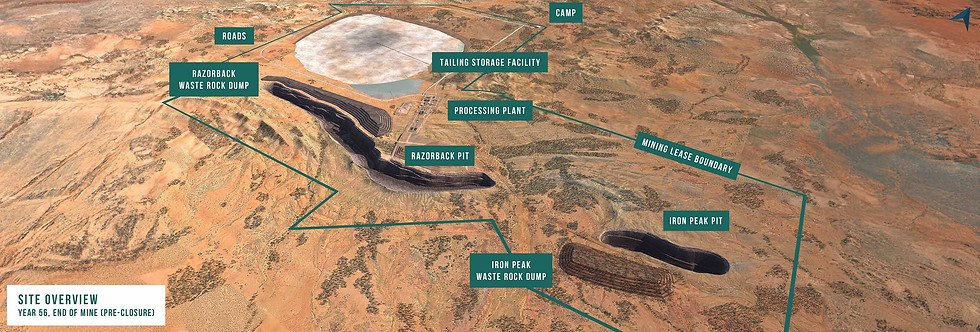
The Razorback Iron Ore Project’s two key deposits, Razorback and Iron Peak, are part of the Braemar Iron Formation, a singular dipping tabular body with minimal structural complexity. The grades, thickness, dip and outcropping geometry of the Braemar Iron Formation are consistent over kilometres of strike. Research commissioned by the South Australian Government has estimated that the exploration potential of the Braemar region is over 50 billion tonnes based on existing mining tenements alone.
Braemar magnetite deposits, which consist primarily of siltstones, are notably softer than those in other iron ore producing regions in Australia and around the world, increasing grinding energy efficiency. In recent metallurgical test work, samples from the Razorback and Iron Peak deposits generated average bond ball work indices of 8.6kWh/t and 6.8kWh/t, respectively. Magnetite deposits hosted in banded iron formations, common to the Pilbara and Mid-West regions of Western Australia, have work indices in the order of 18-25kWh/t (i.e., 2 to 3 times higher).
The Razorback and Iron Peak deposits have negligible overburden (part of the resource outcrops) which is conducive to lower strip ratios and mining costs. In the interim economic update released to the ASX in June 2023, Magnetite Mines estimated a Life-Of-Mine strip ratio of 0.35 for a 91-year, 5Mtpa development at Razorback.

THE RAZORBACK IRON ORE PROJECT
The Power of Potential
The Razorback Iron Ore Project boasts excellent existing infrastructure, including proximity to highways, rail lines, and ports. This strategic location allows for efficient transportation of ore and potential access to 100% renewable energy from the South Australian grid by 2030. Additionally, the project aligns perfectly with the emerging green iron hub concept, positioning it for a sustainable future in the iron and steelmaking industry.

DR-Grade Potential at Razorback
Strategic Expansion for Success
Recognising the evolving market demands, Magnetite Mines strategically increased the initial production scale of the Razorback Project to a minimum of 5 million tonnes per annum (Mtpa) in September 2022. This strategic shift offers a multitude of benefits, including enhanced project economics through economies of scale and wider premiums for high-grade products.
Furthermore, the larger production scale makes the project more attractive to potential partners, customers, and financiers. Additionally, the expansion aligns with the project's significant Mineral Resource Estimate and paves the way for the potential re-estimation of Ore Reserves. It also opens doors for the electrification of key equipment, further solidifying the project's environmental credentials.
Rigorous Studies Validate Project Viability
In September 2022, Magnetite Mines launched Optimisation Studies to redefine the project's scope based on the new 5Mtpa target. These studies built upon the extensive work completed for the previous 2.5Mtpa feasibility study, successfully confirming the viability of the expanded project. They were finalized on schedule in March 2023.
Substantial Resource Upgrade
The comprehensive studies undertaken in 2023, including the additional testwork, culminated in a phenomenal 418% increase in the project's Probable Ore Reserves. This translates to a significant jump from 473 million tonnes to a staggering 2 billion tonnes! This includes a maiden Probable Ore Reserve of 362 million tonnes for the Iron Peak deposit. These updated estimates were derived from an open pit optimisation and incorporate the newly expanded Mineral Resource Estimate which now stands at an impressive 3.3 billion tonnes.
With its unique advantages, scaled-up production, and high-grade potential, Magnetite Mines' Razorback Iron Ore Project is poised to become a significant player in the iron ore industry.
Unlocking High-Grade Potential and Flexibility
As part of the optimisation studies, Magnetite Mines commissioned additional metallurgical testing using new ore samples obtained through their 2022 drilling program. This testing, conducted by industry leaders, validated the project's ability to produce 5Mtpa of high-grade iron ore throughout its lifespan.
Notably, the testing revealed the remarkable potential to produce ultra-high grade 70% Fe concentrates from specific Iron Peak samples, boasting a combined silica and alumina level of just 2.6%. This demonstrates the processing flowsheet's flexibility to adapt to market demands.
Disclaimer
The Mutooroo Ridge Project is at an early stage of exploration. The information presented on this page relates to exploration results only and is based on limited sampling, historical drill data and early stage assessment work. Reported intercepts represent downhole lengths and true widths are not known. The extent, continuity and grade of the mineralisation have not been established and no Mineral Resource or Ore Reserve has been defined.
Further exploration, drilling, mineralogical and metallurgical testwork is required to determine the nature, extent, extractability and potential economic significance of the mineralisation. There is no certainty that further work will result in the definition of a Mineral Resource or that the project will be developed.
All exploration activities and public reporting are conducted in accordance with the ASX Listing Rules and the JORC Code (2012).